As America looks forward to the 250th anniversary of the Declaration of Independence, a battle rages over the history and identity of America. Was America founded as a Christian nation upon the biblical understanding of liberty and undergirding principles of faith and virtue? Or was she founded as a nation upon the humanistic understanding of the Enlightenment and the ideas embodied in the French Revolution: liberte, egalite, fraternite, oh la mort (or else death)? One of the greatest callings for Godly parents is to raise Godly children who also raise Godly children by remembering the works of God. Consider Psalm 78:1-7! This goes against the familiar circular pattern of history that has been recognized in the adage that hard times produce strong men. Strong men produce good times. Good times produce weak men. Weak men produce hard times.
The Great Awakening was a work of the Holy Spirit that changed the hearts and minds of a profound number of people to trust in the sacrifice of Jesus Christ for the forgiveness of their sins and eternal life with God. This movement is crucial to understand the history and identity of America, as it shaped the 13 original United States of America. It stretched o’er most of the 18th Century across several generations and produced spiritual fruit.
A revival does not happen suddenly with nothing preceding it! God is pleased to work through individuals transformed by the Holy Spirit in humility, prayer, and the power and preaching of God’s Word. A critical element of preparing hearts to be receptive to God’s Word is prayer. James 5:16b declares “…for the prayer of a righteous man availeth much, if it be fervent” (Geneva Bible). The Holy Spirit changes hearts through the preaching of His living and active Word. As Romans 10:17 states, “So faith comes from hearing, and hearing through the word of Christ” (ESV). The effect is described in Ephesians 5:13-14, “But when anything is exposed by the light, it becomes visible, for anything that becomes visible is light. Therefore it says, “Awake, O sleeper, and arise from the dead, and Christ will shine on you” (ESV).
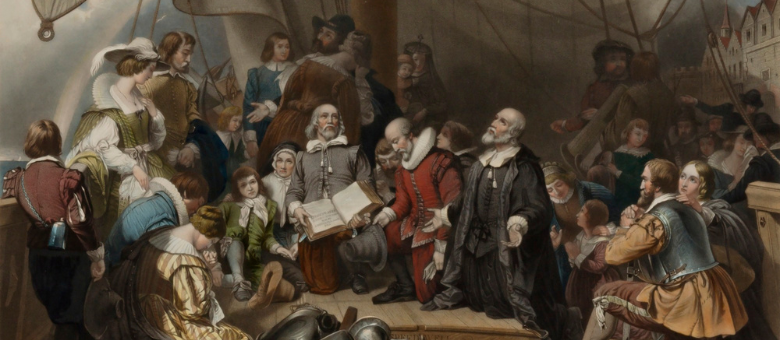
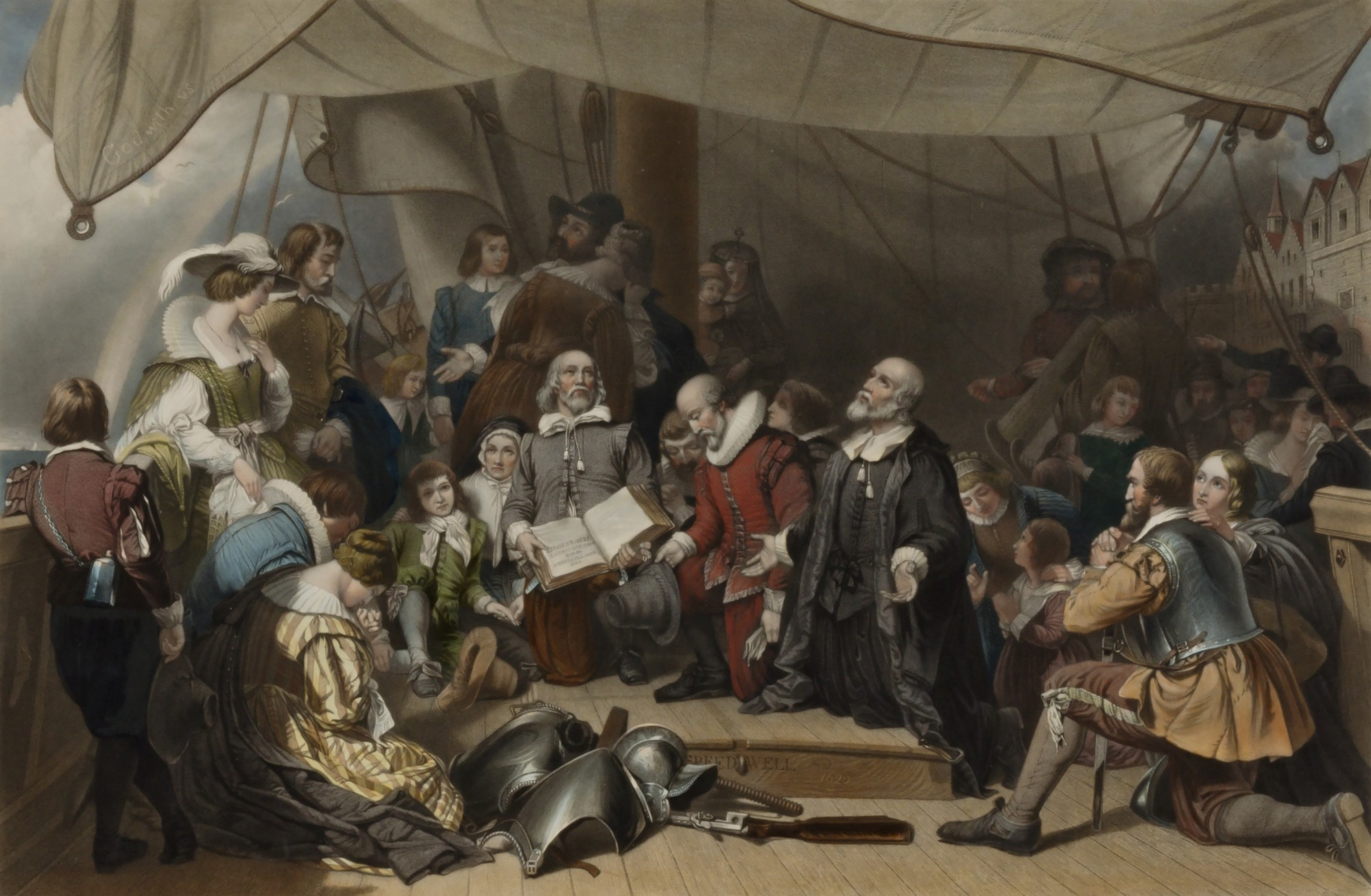
As President Abraham Lincoln observed in his Gettysburg Address, the United States of America was “conceived in liberty.” That conception of American Liberty did not occur in Philadelphia in 1776, but rather on the shores of Cape Cod in 1620. It was there that the Pilgrims wrote and voluntarily signed the first self-governing covenant in civil government in the history of the world known today as the Mayflower Compact. Plymouth Governor William Bradford explained how the compact was the result of revival, saying, “When as by the travail and diligence of some godly and zealous preachers, and God’s blessing on their labours… many became Enlightened by the word of God; and had their ignorance and sins discovered unto them, and began by his grace to reform their lives, and make conscience of their ways… whose hearts the Lord had touched with heavenly zeal for his truth; they shook off this yoke of Antichristian bondage. And as the Lord’s free people, joined themselves [by a covenant of the Lord] into a church estate…” (Bradford 96-99). This obedience to God resulted in individual self-government, which led a church government, and later civil government accountable to God. After the Mayflower Compact, the 1636 General Foundations of the Plymouth Codes, Article I stated, “That no act, imposition, law or ordinance be made or imposed upon us at present or to come, but such as has been or shall be enacted by the consent of the body of freemen or associates, or their representatives legally assembled; which is according to the free liberties of the freeborn people of England” (Holmes 232). Jerry Newcombe states that 100 such Puritan constitutions, charters, and compacts were written leading up to the U.S. Constitution (Newcombe 52). Religious liberty and the congregational form of church government led to civil liberty!
However, as New England prospered, many colonists forgot God. One indicator of the priorities of many was that, during the 1600s, one of the best-selling books in English was entitled The Day of Doom. An eternal perspective began to give way to a love of money and prosperity. During the 1700s, this bestseller was replaced with The Way to Wealth (Schoolfield). In Salem, a breakdown in self, family, church, and civil government led to a hysteria and a miscarriage of justice during the Witchcraft Trials of 1692. Twenty colonists, most of whom were devout Christians who prayed against the practice of the occult, were sentenced to death without a trial, two or more witnesses, and lack of evidence. Yet, a resounding repentance and restitution took place in 1706 (Jehle). Pastor Paul Jehle believes the confession by Ann Putnam Jr., and the forgiveness of her church congregation was the beginning of the Great Awakening. During the 1720s, Pastor Theodore Frelinghuysen of the Dutch Reformed Church in New Jersey was concerned that many church goers were apathetic, with an outward show of going through the motions of worship without a personal relationship with Jesus Christ. God used Pastor Frelinghuysen to preach the Gospel, and many repented of their sins for salvation (Schoolfield).
The importance of education in training pastors became apparent. In Neshaminy, Pennsylvania, the first Presbyterian Seminary in North America began as the humble Log College by William Tennant in 1726 (Myers). Archibald Alexander described the ministers trained at this college, which became the New Jersey College and then Princeton University: “These men may be said to have lived fast. They did much for their Lord in a short time. Being burning as well as shining lights, they were themselves consumed, while they gave light to others. Oh, that a race of ministers, like-minded, burning with a consuming zeal, might be raised up among us!” (Myers). One such minister was Yale University Graduate Jonathan Edwards. Yale was founded in 1701 by ten Congregational (descendants of the Puritans) ministers. The university motto is “Lux et Veritas.” It means “Light and Truth” and is inspired by John 8:32, “…And you will know the truth and the truth will set you free” (ESV). Reverend Edwards became known as “The Intellect” from his study of 13 hours a day (Schoolfield). His most famous sermon was “Sinners in the Hands of an Angry God,” preached in 1741. Despite speaking in a monotone voice, the power and urgency of his examples grounded in God’s Word made a deep impression upon many.
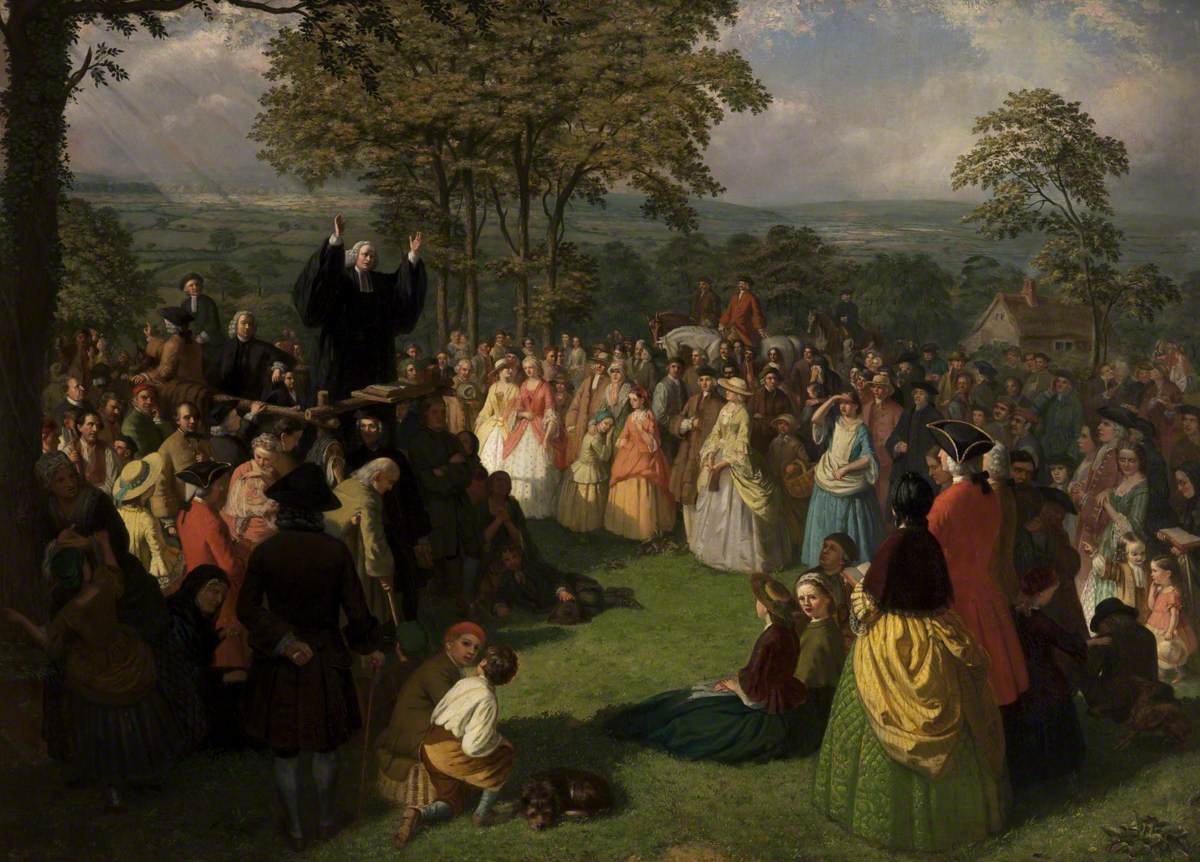
God used ministers in England as well. George Whitefield studied with John and Charles Wesley at Oxford University. After attempting to earn acceptance before a Holy God, Whitefield prayerfully pored over the Bible for a month and trusted Jesus Christ as Savior. Once ordained, his zeal and eloquence in proclaiming God’s Grace burst forth as fire. His bold preaching made him scorned as a fanatic by Anglican Church leaders. Whitefield took to the fields and preached to tens of thousands at a time and heard up to a mile away! Whitefield possessed a sensational voice and manner. His storytelling was worthy of an Arabian proverb, “He is best an orator who can turn a man’s heart into his ears” (Ryle). When he described a storm at sea, a sailor in the audience cried, “To the lifeboats” (Ryle)! His clear and earnest words were delivered with tears, truth, humility, and love. From 1739 to the year when he died in 1770, he was devoted to sharing the Good News. There was hardly a town in England, Scotland, or Wales he did not visit as an evangelist. He visited the Colonies seven times and Ireland twice. Mark Galli summarized Whitefield’s legacy:
George Whitefield was probably the most famous religious figure of the eighteenth century. Newspapers called him the ‘marvel of the age’. Whitefield was a preacher capable of commanding thousands on two continents through the sheer power of his oratory. In his lifetime, he preached at least 18,000 times to perhaps 10 million hearers (63).
After serving as an Anglican missionary and pastor to Georgia with limited success, John Wesley’s heart was changed by God in 1738. Over the next 50 years of ministry, Wesley rode over 250,000 miles on horseback while preaching the Gospel. This is equivalent to riding around the equator of the Earth ten times! He preached an estimated 40,000 sermons (Thomas). His brother, Charles, wrote over 6,500 hymns (Mills). The sacrifices and efforts by such ministers were not in vain.
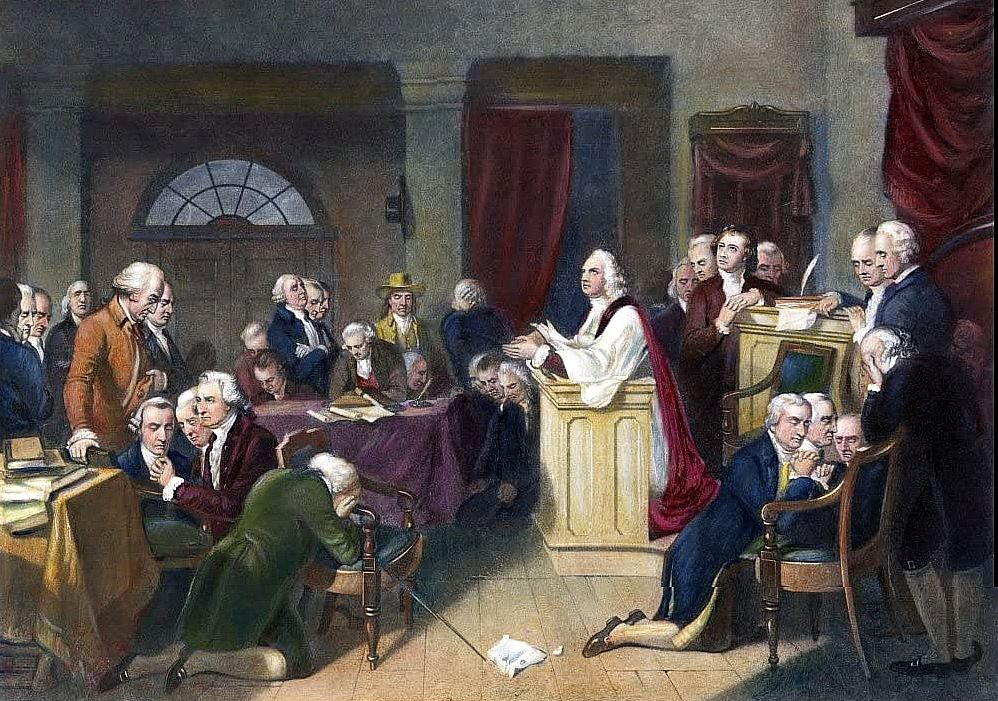
The spiritual revival of the Great Awakening united the Colonies with courage and trust in Divine Providence, laying the foundation for biblical worldview to resist the tyranny of unlawful acts of British Parliament and King George III. A popular slogan was “No king but King Jesus” (Severance). The colonists followed the biblical doctrine of the Interposition of Lower Magistrates, which states that lower magistrates (the representatives of the colonists) protect the God-given liberties of the people under their jurisdiction. The Declaration of Independence appealed to the “Supreme Judge of the world” for the righteousness of their cause and declared a “firm reliance upon the protection of Divine providence.” The constitutions of each of the original 13 states that formed the United States of America acknowledged God as the source of their liberty (Newcombe 238). They also required that office holders declare their accountability to God by professing faith in Jesus Christ (Wilson). May we remember and honor the covenants made by our nation’s founding spiritual and civil leaders to trust in God alone and bless our neighbors as we have been blessed by those who have gone before us.
Aaron Bradford teaches history at Dayspring Christian Academy.
Works Cited
Bellin, Samuel and Robert Walter Weir, Embarkation of the Pilgrims. Smithsonian American Art Museum, Gift of International Business Machines Corporation, 1966.48.14, https://americanart.si.edu/artwork/embarkation-pilgrims-1752
Bradford, William. Of Plimoth Plantation, Colonial Society of Massachusetts and the New England Historic Genealogical Society, 2020.
The Bible. English Standard Version. Crossway, 2021-2025. https://www.esv.org/
Galli, Mark. 131 Christians Everyone Should Know. B & H Publishing Group, 2010.
The 1599 Geneva Bible, Tolle Lege Press, 2006.
Holmes, Abiel. The Annals of America, from the Discovery by Columbus in 1492 to the Year 1826, Hilliard and Brown, 1829.
Ryle, J.C. Select Sermons of George Whitefield. Banner of Truth, 1997.
Jehle, Paul. “SPIRITUAL WAR: The Salem Witch Trials of 1692.” Proclaim Liberty, Heritage Institute Ministries, vol. 3, no. 3-4, 1992.
Matteson, Tompkins Harrison. The First Continental Congress at Prayer. 1848. https://commons.wikimedia.org/wiki/File:First_continental_Congress_at_Prayer.jpg
Mills, Frederick V. “Charles Wesley.” New Georgia Encyclopedia. 9 January, 2017. https://www.georgiaencyclopedia.org/articles/arts-culture/charles-wesley-1707-1788/
Myers, R. Andrews. “The Story of the Original Log College.” Log College Press. 28 December 2017. https://www.logcollegepress.com/blog/2017/12/27/the-story-of-the-original-log-college
Newcombe, Jerry. The Book that made America: How the Bible Formed Our Nation. Nordskog Publishing, 2009.
Schoolfield, Brenda. “The Great Awakening: Spiritual Revival in Colonial America.” Youtube, uploaded by Vision Video, 8/15/2025, https://www.youtube.com/watch?v=vELS8e8hATk
Severance, Diane. “What was the Great Awakening? Key Events and Figures.” Christianity.com. 23 April, 2023. https://www.christianity.com/church/church-history/timeline/1701-1800/the-great-awakening-11630212.html
Thomas, Arthur Dicken. “Profiles in Faith: John Wesley.” 5 June, 2003. https://www.cslewisinstitute.org/resources/profiles-in-faith-john-wesley/
Walley, Thomas. George Whitefield Preaching in Bolton, June, 1750. 1863. Bolton Museum & Art Gallery. https://artuk.org/discover/artworks/george-whitefield-preaching-in-bolton-june-1750-163882
Wilson, Douglas. “America… Christian From the Get Go.” Blog & Mablog. 23 June, 2025. https://dougwils.com/books-and-culture/books/christian-from-the-get-go.html